The Monday forecast call
You already know which three deals in commit are not going to close. So does your CRO. The call is about who says it first.
 Book a free pipeline readBook a call
01 · For VPs of Sales, Sales Directors, and Sales Managers
Sales Rep OS runs on every rep’s machine: a morning brief, call prep, follow-ups drafted from the transcript, call scorecards, and a weekly pipeline review with evidence per deal.
We set it up around your CRM, your call recorder, and the way you sell. Then we train the team on their own accounts until every rep is running it.
What sales managers and reps say about Sales Rep OS
5 out of 5 stars
“We’ve added 30+ new qualified conversations every month with the same four reps. This tool is incredible”
5 out of 5 stars
“Fewer deals get lost. It's so easy to see prospects that need a follow up and the overall health of our pipeline”
5 out of 5 stars
“I bought Claude subscriptions for the team last year and nobody used it. No one wanted to actually figure it out. This tool walks you through getting set up step by step and makes it easy for anyone”
5 out of 5 stars
“5 out of 5 stars, I got it for one of my AE’s to start - he loves it and now I’m rolling it out to the whole team”
5 out of 5 stars
“This tool is incredible, every sales rep needs it in their toolbox.”
5 out of 5 stars
“Inbound leads get a researched first touch within the hour. Our demo show rate went up because we're reaching people while they still care.”
Trusted by
Global and growing brands





02 · You know the week
You already know which three deals in commit are not going to close. So does your CRO. The call is about who says it first.
CEO texts you. You Slack the rep. The rep answers from memory. Nobody opens the CRM, and the board deck gets built from a different view than the forecast.
The 1:1 was supposed to be coaching. It turned into "when will this close?" again, because admin has a deadline and coaching does not.
48%
of AEs hit quota in 2026, down from 51% in 2024.
The Bridge Group, 2026 AE report
80%
of sales and finance leaders missed a quarterly forecast in the past year.
Xactly forecasting report
72%
of sales orgs say the hours AI saves reps are not being reinvested in selling.
Gartner, May 2026
The forecast is not a data problem. It is a trust problem. Every tool sold against it so far inherited the same untrusted CRM inputs, which is why the real forecast still lives in a spreadsheet. The fix is upstream: capture what the buyer said, on the day they said it, and put it where the roll-up can see it.
03 · What your reps see every day
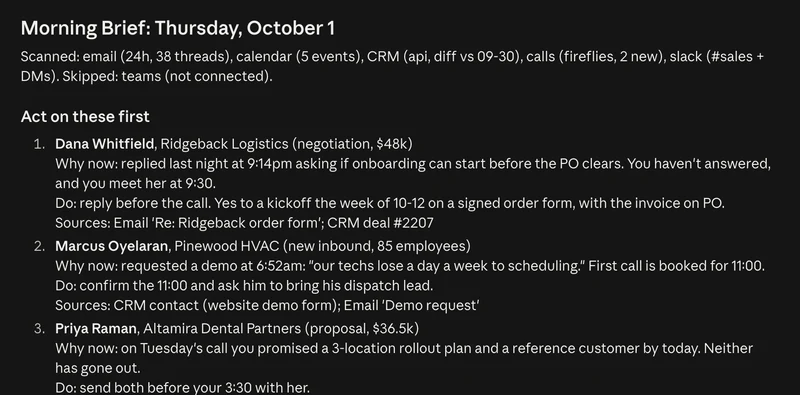
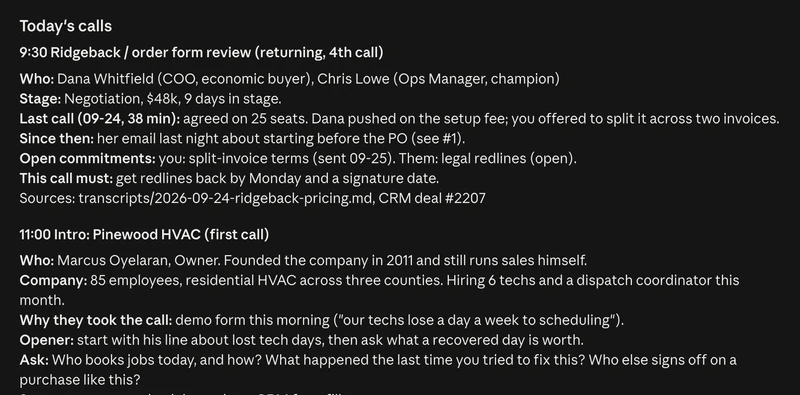
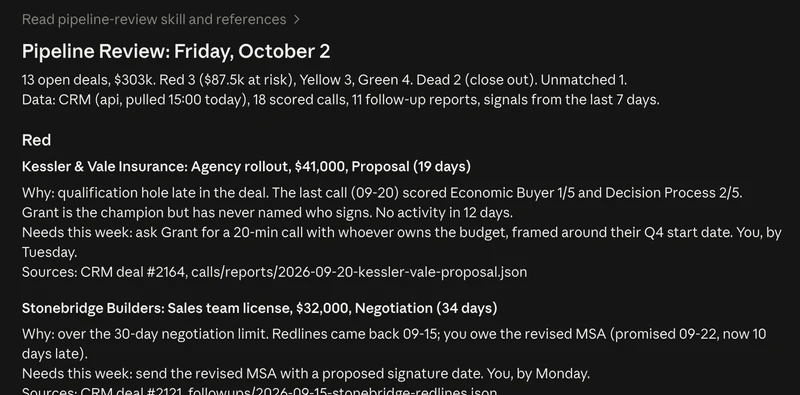
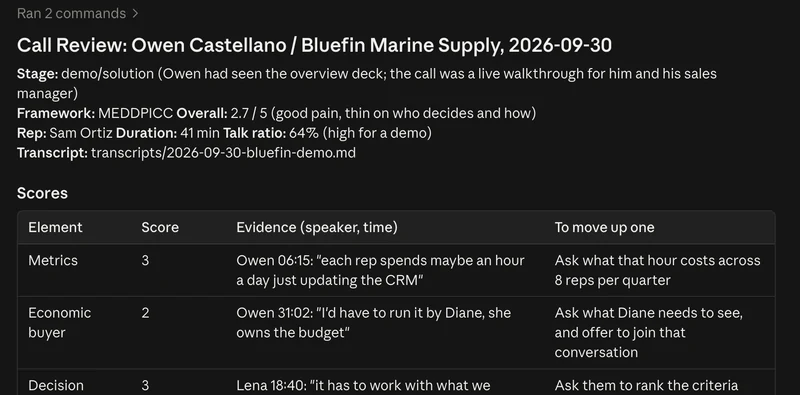
Morning brief, call prep, pipeline review, call scorecard. Real screens from a running workspace.
04 · What it does, and what that means for you
Every week, each rep gets their open deals grouped by risk, with the evidence from CRM activity and call transcripts and a suggested next action for each. Stalled deals surface before the roll-up, not after.
For you: a forecast call built on what the buyer actually said, not on the stage field.
The watcher checks for new call recordings every 30 minutes. Each one becomes a draft in the rep’s voice, a list of next steps, and feedback on the call. The rep reviews and sends. Nothing goes out on its own.
For you: commitments and next steps captured on the day of the call.
After a call, the rep sees the proposed activity, next step, and stage change, and confirms with one yes. It is the only path that writes to your CRM. No required fields, no nagging in Slack.
For you: deal truth lands in the CRM as a by-product of the work, not as a Friday chore you chase.
Every recorded call is scored against your framework (MEDDPICC, BANT, SPIN, Sandler, or Gap Selling) with transcript lines as evidence and specific coaching notes. The 1:1 starts from the scorecard instead of a close date.
For you: you know which two calls to listen to this week, and why.
Each morning the rep gets prioritized contacts, the reason to act, and a suggested next step, pulled from your CRM, email, calendar, calls, and Slack. No one decides who to call first from a blank screen.
For you: inbound gets a researched first touch while the buyer still cares.
Prospecting runs look for companies that match your ICP and show a buying signal, then enrich contacts through your own data provider with confidence labels. Reps review the research and decide who to contact.
For you: self-sourced pipeline without a new SDR seat and without an AI SDR sending in your name.
05 · The 6pm email, written at 2:35pm
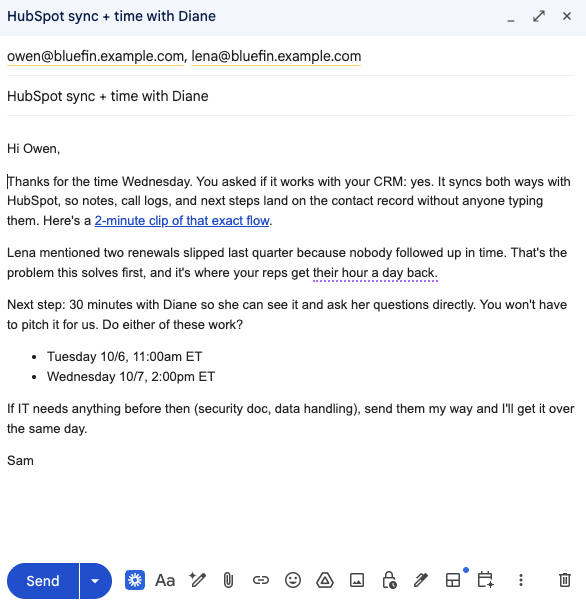
A draft in the rep’s voice, grounded in what the buyer actually said: their questions, their priorities, the people involved, and the commitment that was made on the call. The rep edits and sends. The next step and the CRM update are queued behind it.
For the manager, this is the part that ends the chase. Commitments get captured the day they are made, so the pipeline review runs on evidence instead of memory.
06 · What “set up for your team” means
You have bought software that the team ignored. This is not that. We do the setup with each rep, on their deals, and we stay until they are using it without us.
HubSpot, Pipedrive, and GoHighLevel connect directly. Other CRMs get an adapter built during setup, or run from a CSV export. Call recorders: Fireflies, Fathom, Gong, Zoom, or a folder of transcripts.
Your ICP from your own closed-won data, your call framework, your stage definitions, your buying signals, and each rep’s writing voice from their sent emails. The workflows are files your team can read and change.
Live sessions on live deals, not a demo account. Every rep leaves running the morning brief, the call prep, and the follow-up on their own machine. The people who never touched AI and the people pasting whatever it says get different training.
Scheduled jobs run the brief, the transcript watcher, prospecting, and the pipeline review on the cadence you choose. The playbook grows every week from your team’s own calls: objections, commitments, lessons.
07 · Read this before the call
You have been sold activity before: lists, sends, booked meetings, logins. Here is where this stops, so you can decide whether it is worth 30 minutes.
08 · A strong fit when
09 · How we work with a team
“I now feel ready to lead my team through what is sure to be the most transformational technology to ever impact knowledge workers.”
“What impressed me most about working with TitanStack AI wasn’t just the technology, it was how they operated as an extension of our team. They handed us a clear, prioritized path forward instead of a black box.”
“I’m now much faster at getting the AI to work for me, I understand how the systems fit together, and I can diagnose and fix issues on my own, something I couldn’t do before. It probably would have taken me a year of trial and error to get here.”
10 · What happens on the free pipeline read
We ask how the forecast call runs today, where deal information actually lives, and what the team already tried. If the rollout fits, we scope it and send a fixed price. If it does not, we say so and you keep the notes.
11 · Questions sales leaders ask
A Claude subscription each (Pro at minimum; Max once the scheduled jobs are doing real work), Claude Code on a Mac or Linux machine, and the training sessions. No coding. Windows runs everything, but the scheduled jobs are set up by hand in Task Scheduler during setup.
HubSpot, Pipedrive, and GoHighLevel connect directly. Any CRM with a token API gets an adapter built during setup. Anything else works from a CSV export, with two limits: no daily CRM activity in the brief and no write-back. Recorders: Fireflies, Fathom, Gong, Zoom, or a folder you drop transcripts into.
That is what the training is for. Setup is done with each rep on their own accounts and their own deals, and the daily brief arrives on a schedule rather than waiting to be opened. If a rep is not running it by the end of training, we keep working with them until they are.
The workspace files live on each rep’s machine. Claude processes the context the workflows use, and your connected services handle their own API requests. Local files do not mean every step stays on the device, and we walk through this on the call.
It depends on how many reps, which CRM, and how much configuration your motion needs. We scope it on the call and send a fixed price afterward. If the team is too small or the stack does not fit, we will say so on the call.
Teams that want something to send on a rep’s behalf; this never will. Teams that need one manager dashboard today; this is one workspace per rep, and a roll-up is not built yet. Teams that do not record calls and will not start; the brief, prospecting, and pipeline review still run, but scoring, follow-ups, and the playbook need transcripts.
12 · Start with the forecast
Book the free pipeline read. Thirty minutes on your pipeline and your process, and a straight answer on whether this is worth putting on your team.
Book my free pipeline read